
The idea behind this article all started when someone recently asked me what travel photographer do I follow and find inspiration from. And I just didn’t have any answer to that! I think the reason why is that, first, I am much more inspired by street photographers today, whose work can be really unique and creative. But also because when I try to look at travel photos on Instagram, I often end up seeing the same images, or the same types of images.
Of course we all have different feeds and algorithms showing up on our screens. But mine is really depressing.
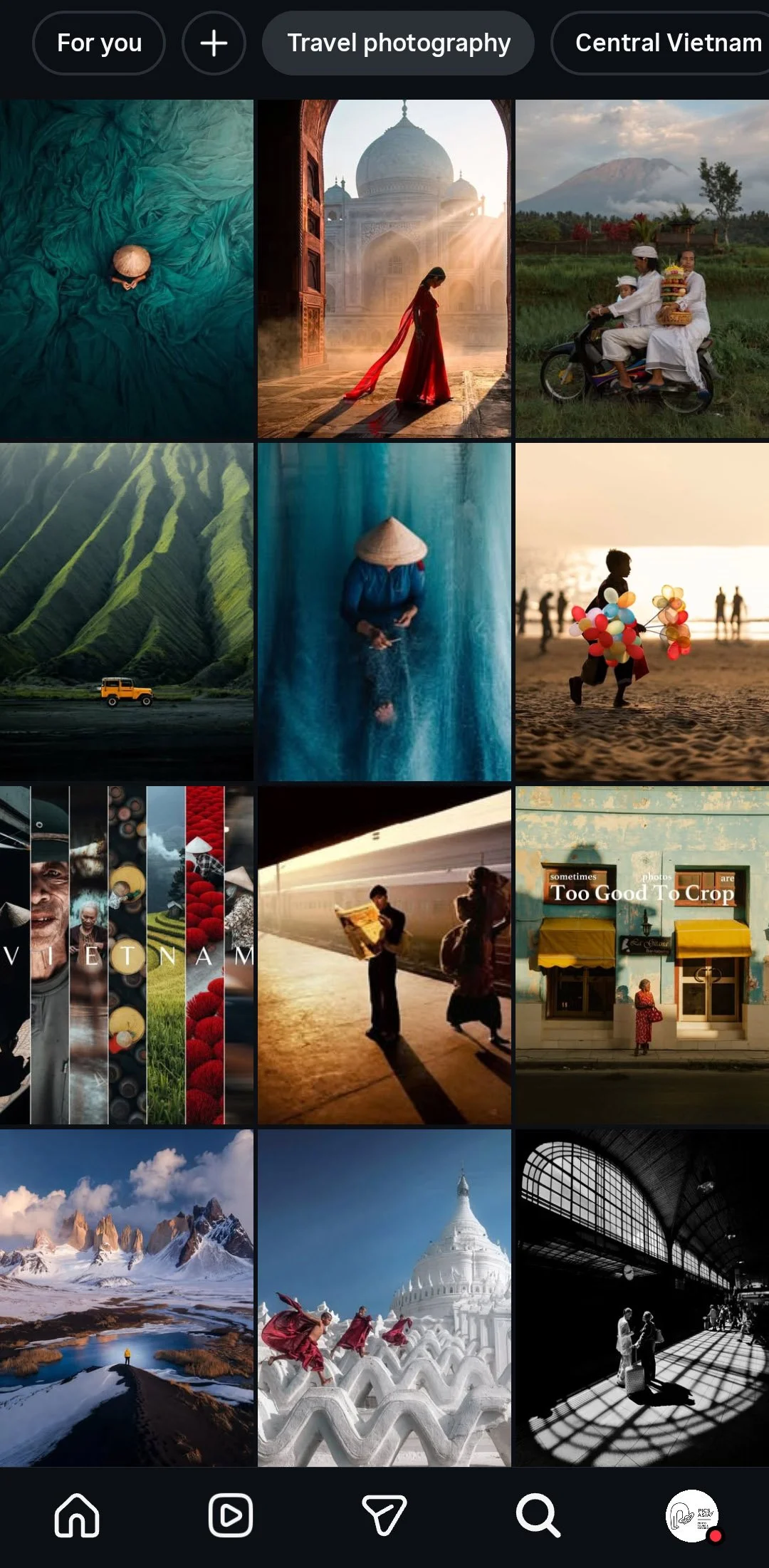
When I open Instagram and look for Travel Photography, here is what I see
From the classic “selfie” to the already seen thousand times before staged travel image of the Vietnamese fishing nets. Only a few cool street shots.
Have you seen some of these images before?
Have you ever scrolled through travel photography online, or watched the winning photos from an online competition, and had the strange feeling you'd already seen the exact photo before? Not a similar photo. The same photo. Same pose, same light, same grandmother posing through the same doorway, same buffalo. I have actually listed many of these images in my Library of fake photos in Asia.
That feeling isn't a coincidence. There's a specific way of making travel photos that produces exactly this kind of repetition, and I think it's worth pausing on — not to tell anyone what to do, but to ask a genuine question: is this actually good for photography, or is it quietly working against the thing that makes travel photography worth doing in the first place?
What's actually happening
I call it Contrived Travel Photography. It works roughly like this: a photographer sees an image online that they love. They travel to the location where it was taken (or one like it), arrange for a model, a costume, a prop, a specific light — and recreate it. It's actually much easier than that, as it's most often done through a tour that takes a group of photographers to a pre-arranged spot with a pre-arranged "subject," so that everyone can leave with their own version of the same shot.
There's nothing sinister about wanting a beautiful image, and there's nothing wrong with staging a photograph in itself — that's the entire foundation of fashion and commercial photography, and it produces extraordinary work. The question worth sitting with is a narrower one: what happens when a staged, art-directed image is presented — through a caption, a category, a competition entry — as travel photography, documentary work, or even photojournalism? Is that still the same thing as travel photography, or is it something else wearing its clothes?
The myth of the "authentic" shot
Travel photography, at its core, has always claimed a kind of relationship to truth — an idea of showing a place and its people as they actually are, not as we'd like them to be. But authenticity is a slippery thing. Cultures aren't static. The rice farmer using a buffalo yesterday drives a small tractor today. What we call "authentic" is very often just a memory of something we saw in someone else's photograph, years or decades old, that we're now trying to recreate as though it were still simply true. We could even push the criticism further by saying that most of these versions of "authenticity" we see online come from a post-colonial view of what Asia should be like.
So here's a question worth asking honestly: when a photographer arrives with a specific final image already in mind — a monk reading in candlelit smoke, a fisherman silhouetted at dawn, a boy throwing a duck into golden light — whose vision are they actually capturing? The place in front of them, or a picture they already carried in their head before they got there? And can we still call this travel photography?
Why does this spread?
It isn't hard to see why this style of photography is popular. It's efficient. You don't need to wait, wander, get lost, fail, or come back empty-handed the way genuine travel photography often demands. You arrange the elements, and you get a reliably beautiful, reliably shareable result — the kind that performs well on social media, and the kind that, for whatever reason, keeps showing up as a winner in photography competitions.
On top of that, you've seen these images get really "successful" on social media, amassing thousands of likes. So it's very tempting to try and recreate them to "boost" your photography career, or simply to get more likes. And, well, why not enter and win a photo competition while you're at it?
And that raises another question. If a jury rewards an image that closely resembles dozens of others already circulating online, what exactly is being rewarded — the photograph, or the ability to correctly reproduce a formula? Is a competition celebrating original vision, or is it quietly training an entire generation of travel photographers to chase the same handful of images, over and over, because that's what wins?
There's also a newer version of this worth naming: photographers who see a specific viral or high-performing image and go to near-identical lengths to reproduce it, sometimes down to the pose, the crop, and the wardrobe — not because the moment moved them, but because the format is proven to perform. It's worth asking what that does to us as photographers, and to the work itself. If the goal becomes matching something that already exists as closely as possible, where does that leave room for anything of our own?
We already have AI that does a great job of copying other photos found online. Why would you want to do the same?
Be fair to the original photographer
You may think that the original photographer who (staged and) took the image first will feel "flattered" that their image is being copied by many other photographers. But I don't believe that most of them are. They may have put a lot of effort into the conceptualisation and creation of that image, only to see it replicated online — and potentially winning awards that they themselves didn't win, or even enter. How would you feel if you were in their shoes?
Also, (and one that may be one of the worst parts of this dark side of travel photography I have witnessed), I have seen photographers “fighting” online, claiming that they took the shot first, or that they took it better than the other photographer who took exactly the same shot. For real? This definitely proves my point that photographers who do these types of practices often do it for the “fame” or the “likes”, and not for the act of taking photos.
What gets lost
Travel photography starts with the travel. Real, unscripted encounters — with people, with a place, with the parts of a day you didn't plan for — are unpredictable by nature. You don't fully control the light, the moment, or the person in front of you, and that lack of control is exactly what pushes a photographer to adapt, notice, and see something they haven't seen before. It's also, often, uncomfortable — you can spend a whole morning with nothing to show for it. But this is how one learns to become a better photographer and actually has a chance to develop their unique photography style.
Why not make your photography yours?
Contrived photography removes that discomfort, but it may also remove the thing that makes an image genuinely yours. If the scene has already been decided before you press the shutter, how much of what appears in the frame is actually a discovery, and how much is simply execution?
There's a second cost worth naming too, separate from creativity: what happens to viewers who take these images at face value? If a place becomes known, visually, through a series of staged and recycled scenes, are people actually learning something true about it — or learning a version of it that a handful of photographers, chasing the same shot, decided to manufacture?
An open question, not a verdict
I don't think there's anything to be gained by telling other photographers what they should or shouldn't do with their own work — that's genuinely up to them. But I do think it's worth each of us asking, honestly, next time we're chasing a shot we've already seen: is this photograph teaching me something, or am I just confirming something I already believed before I got here? Is it moving the craft forward, even a little — or am I adding one more copy to a pile that was already too tall?
I don't know if Contrived Travel Photography is on its way out. Maybe audiences will eventually get tired of seeing the same frame again and again. Maybe they already have, and just haven't said so out loud yet. But the photo competition winners from the past decade are telling me that this trend isn't fading away. And when I spend some time scrolling for travel photos on Instagram, I don't feel confident that the general craft is improving either, especially amongst more beginner photographers.
Either way, I think the more useful question isn't whether this style of photography will fall out of fashion — it's what we, individually, want our own photography actually to be about.